

Canon Lenses
- Details
- Category: Canon Camera Lenses
Good, cheap lenses for digital SLR cameras are hard to find, especially a good cheap 50mm lens for a Canon DSLR. Make sure you read this entire article because you will be very surprised at what you will learn.
A 50mm lens is practically a requirement for every single lens reflex camera owner. This is not a wives' tale, it is the "old" industry standard. The development of zoom lenses has made the "50mm rule" a relic. Many photographers who are new to the business or hobby are not aware of the premise at all.
However, when you consider the quality of images that are produced with prime lenses verses zoom lenses, the prime lenses win almost every time.
Canon has developed the technology of the 50mm lens to a point where it really should be a "standard" in every photographer's kit.
Ad Adorama
Think about it. Changes in focal length that happen during the "zoom process" necessitate much more complex technology to deal with unwanted effects like barrel distortion or vignetting. Since the Canon 50mm lenses are already fantastic in their engineering, if a new development in lens glass comes along, they just have to replace the glass and all is good.
There are 3 models of the 50mm Canon lens.
** 50mm f/1.2 L - expensive but fantastic (it's an L lens)
** Canon EF 50mm f1.4 USM - the mid-grade lens with excellent image quality
and a very competitive price point
** 50mm f/1.8 - cheap but fantastic
There is not much difference to note unless you look a little closer. The aperture and the quality of construction are where the differences come in to play. At the top of the list is the most solidly built lens, in fact the top two have a better build quality, and the also contain more glass elements than the third one. But it is image quality that is the determining factor to the viewer, the the image quality of these three lenses is very close indeed. This is especially true for someone who views your images with a "normal eye" .
Canon has essentially taken the great technology and used some less expensive "wrapping" in the form of plastic casing to make the 50mm f/1.8 lens really affordable for virtually every Canon DSLR owner.
Aside from producing really good images, this cheap 50mm lens for Canon cameras has another really distinct advantage for photographers who are just entering the digital SLR market with cameras such as the Rebel or the newest mid-range 60D model. Because of the 1.6 "crop factor" of these cameras, the 50mm lens length becomes the same as 80mm on a regular 35mm camera. This is the perfect length for doing portraits and other similar photo jobs that require a medium telephoto lens.
Here is the plain truth. If you purchase any zoom lens in the $100 price range, you will definitely be getting a consumer grade product with less than stellar image quality. If you purchase the cheap 50mm Canon lens, you will be getting top of the line image quality.
The main gripe about this lens is that is feels cheap, and while this may be true, the resulting images do not look cheap at all.
Even a lens built like this can last for a long time if proper care is taken.
Hopefully, you are ready to find out much more about this dandy little "cheap" Canon 50mm lens. To find out which Canon lens is the right choice for your Canon digital SLR click here.
Author
Wayne Rasku
- Details
- Category: Canon Camera Lenses
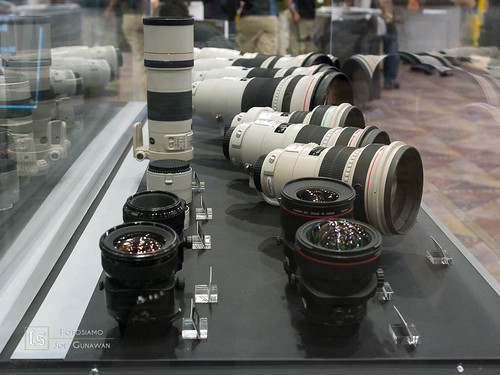
Canon easily has the widest range of lenses that a photographer can think of, and that trend appears to be holding steadfast across their camera lines, too. From ultra-wide lenses to telephoto lenses, you can be sure that you can get one that suits your expansive tastes and budgets. For those that have been looking for some lenses for their Canon camera, here are some of the best which provide bang for your quickly fleeting bucks, taking high and low budgets into consideration.
Value Lenses – The EF 50mm f/1.8 II by Canon
There are reasons why the 50mm f/1.8 lens by Canon is one of the must-haves for any Canon users. The lens is not only cheap but also light and fast. It works well with both full-frame and crop body image handling, and is certainly one of the favorite lenses to go with when it comes to portraiture. However, because it is cheap, it also means that the body is made out of plastic and has an older, less responsive focusing system. Nevertheless, it is a great lens to have, especially when operating at aperture above f/2.0. Professionally speaking, that’s pretty darn good.
Value Lens – The EF 70-200mm f/4L IS USM by Canon
As compared with its bigger and bulkier f/2.8 IS II USM variant, the Canon EF 70-200 f/4L IS USM is certainly a good telephoto lens for those that simply cannot afford the aforementioned variant. The built-in IS means that it can compensate for a few stops of aperture and when taking videos, Image Stabilization can be a blessing as well. The tripod collar for this lens, however, costs a bit more than $100, which leads us towards another question to consider when lobbying for value lenses: how much is too much for tripod collars?
Value Lens – The 70-300mm f/4-5.6 Di VC by Tamron
If you want a telephoto lens that will cost you less than $500, the one by Tamron can be considered. The vibration compensation (VC) is similar to Canon’s IS technology and this will give the user 3 stop stabilization. The optics on the Tamron 70-300mm f/4-5.6 Di VC is good and can almost be compared with the 300mm prime lens by Canon. One potential downside of the lens is that it has a variable aperture.
High-end Lens – EF 70-200 f/2.8L IS II USM by Canon
This lens is without a doubt, a must-have for any photographer that can afford it. Suffice to say that when you go to an event that has professional photographers, you will definitely see this lens being used by them. It has a silent USM focusing and the new IS II is much better than the one before. On a cropped body, you will get an effective range of 105-300mm.
In The End…
All that really counts is what you’re comfortable learning, spending and wish to implement into your daily pictography needs. Once you’ve chosen the lens, make sure you’ve factored in collar costs and other protective sheaths to assure this hefty investment holds value for decades to come.
About The Author
Roger Kowalewski is a freelance writer and gadget guru from Indiana.